Showing posts with label coursera. Show all posts

Monday, September 21, 2015

Happiness - A life of Happiness and fulfillment by Rajagopal Raganathan

                                                               
Took a course on Coursera by Dr Rajagopal Raghunathan from Indian School of Business on 'happiness' and really liked it. Here are my notes from the course, may help you becoming happier.
  • Happiness definition types
    • Sensory - Physical like food, vacation etc
    • Hubristic - success, wife etc
    • Authentic - mastery at a skill
    • Love/Connection - with a person, place, animal or activity
    • Abundance/joy - Have everything you need, challenges in life make it interesting not threatening
    • Serenity
    • Interest
    • Amusement/Laughter
My happiness : Being content with what you have like abundance/joy regardless of how much (or little) you have. Achieved due to 'fatalistic attitude through religion - Not everything in control, better to accept and appreciate what you have.'

HAPPINESS SINS
There are certain things that are really harmful in your search for happiness. These must be avoided.
  1. Devaluing happiness - Fundamental Happiness Paradox - routinely sacrifice happiness for other goals eg money, fame etc ironically these are assumed mediums towards happiness itself. Having your own definition of happiness helps in dodging this sin. Some misconceptions about happiness, it makes us lazy, makes us selfish, and happiness is fleeting.
  2. Chasing superiority - to get others approval, boost self esteem, progress towards mastery, to seek autonomy. Problem is you get separated from others, creates envy (takes away happiness) and never fully achieve superiority anyway. It difficult to measure oneself against others on dimensions that matter (skill,talent) so we use materialistic yardsticks to measure and become materialistic which takes away happiness (causes loneliness, adaptation to materials and desire for more), chasing superiority makes us self-centred and disliked by other leading to less happiness. It also leads to extra stress to gain superiority which results in lower performances (non-physical tasks)
  3. Need to be loved (belong), need to be alone - we mimic others to be liked by others (due to our social nature). We care more about what others think than what we ourselves think. Social rejection is as painful as physical pain. Neediness and avoidance of social links both lead to unhappiness. Neediness is based on the scarcity principle, 'we like things we are denied', neediness is not good for happiness because its not an attractive trait, you seem less respected by other n yourself, neediness attracts emotionally cold people leading to wrong kind of relationships. Avoidance lowers happiness because its against our nature, gets us less cooperation, make us less satisfied by others support, avoidance leads to loneliness. 'Secure attachment' - middle ground. 
  4. Being overly control seeking - because we do better emotionally and physically when we are in control. Control allows to aim and achieve higher but obviously too much control can be very difficult and harmful. Psychological reactance - your attempt to control others leads to them doing the opposite. You can either have control or love. If you try to control others, others wont like you, leading to lowering your happiness. Wanting the control, leads you to depend on having control too much, which is mostly unachievable. Diversity of opinions is limited among controlling people, hence best choices will not be made. If you try to control outcomes, youll fail frequently cause many things cant be controlled, hence youre frustrated and less happy. Good way is to pursue passion in a harmonious way rather than an obsessive way. When obsessive, passion controls you rather than you controlling the pursuit. میانہ روی  (middle ground)
  5. Distrusting Others - Trust in others correlates with happiness, however we are hard-wired to not trust others. Its important to 'pro-actively trust' others. Perceived trust is usually much lower than actual trust. (Lost wallet example). Others are more trustworthy than we think. Also, when we trust them they trust us back.  
  6. Distrusting life - We shouldn't rely on outcomes for our happiness. Positive outcomes could have negative consequences and vice versa. Only 10% of happiness are due to external circumstances. When things happen to you, its not obvious if its a good thing or a bad thing. Studies show people are happier being busy (even for a silly flimsy reason). We can derive all our happiness in the process of working towards outcomes. So we can be happy regardless of linkages with outcomes. De-linking happiness to outcomes should occur 'after' the outcome has occurred i.e. you'll always have preferences but once they've occurred, it shouldn't matter, this is called pre-occurrence preference.
  7. Ignoring the source within - See mindfulness in happiness habit # 7 below for details. 
HAPPINESS HABITS
These are the habits you need to adopt to be happier in your life.
  1. Prioritise but do not pursue happiness - This means that we analyse decisions keeping in mind our happiness but do not constantly trying to go after happiness or obsessing over it, latter gets us into stress in trying to achieve it and/or results in over expectation of level of happiness that were trying to achieve
  2. Pursue flow (superiority problem solver) - Get into the flow. Happens in the absence of anxiety and boredom when you are stretched just the right amount. Flow experiences are meaningful. flow gives you charisma. To find flow, find what you like doing, nurture your talent and identify world needs your talent fulfils. When things are not going well, practice self compassion, which is to treat yourself like how you would treat a close friend. Recommend for yourself what you would for the friend.
  3. To love and give - To strengthen relationships and feel secure, practice self-compassion and gratitude, the need to love (give). Donating to charity creates as much happiness as doubling of our salary. Direction of causality not clear. We have an innate desire to be helpful. Generosity makes us happy (conditions apply). We are hard wired to it, makes u feel competent, reciprocity thoughts, Giving helps us earn more, but you cant be a selfless giver but an otherish giver. These people are the happiest. Givers are more likely to be most successful and also least successful. difference is they care about themselves also. they are otherish as opposed to selfless or selfish. They contain cost of giving, 'am i the right person?', help multiple people. Exercise value extending stuff, allow themselves to feel gratitude, pride, say No at times. See impact of giving, and make generosity fun.
  4. Taking personal responsibility - Don't blame others, regulate yourself. Imaginations bigger influence on emotions than reality. Humans have an ability to regulate your emotions. Control yourself rather than the external environment (others and outcomes) and your feelings will change. It takes time to develop the ability to regulate your feelings.
When you have control over your feeling, your pre-frontal cortex is more available to you and you make better decisions.When you lose control over your feelings, your limbic system takes over the functioning of your brain and you arent able to think clearly.


Regulating emotions helps overcome overly controlling behaviour because you no longer are dependant on outcomes or others for your happiness. When we aren't feeling good internally, we seek external control, and when we don't have external control, we seek ways to gain internal control through religion, that's why religious people tend to be happier. (Gods presence as controller).

Personal responsibility -> Internal control -> lesser need for external control -> less control seeking -> people will like you more, cooperate with you, you make better decisions.

Emotion regulation can be done by several way. Suppressing your emotions is a bad way to do it; or 1) avoiding situations with negative feelings 2) labelling (not discussing/ analyzing) your emotions to yourself (amazing one) 3) Attention diversion from negative towards positive ones (without self serving bias) and 4) Cognitive re-appraisal, be happy about your low level problem. Some uncertainty and lack of control is good, very high control means boredom, very low means anxiety. 

A healthy lifestyle also helps control emotion, its done by eating rightmoving more and sleeping better

Eating healthy - Avoid sugar (causes cancer) and trans-fats (aggressive behaviour and depression), more fruits and vegetables (better skin). Healthy snacks in reach, smaller non-white plates, carry fruits with you, eat regularly, eat healthy stuff first and a healthy breakfast.
Moving more - Sit for less than 6 hours/day even if you're exercising a lot. Use fit-bits, move regularly, exercise at home in the morning, walk a mile/day, 6 days/week. 
Sleeping better - Sleep 7+ hours/day. Allows the brain to cleanse itself of toxins. No TV or electronic gadgets (reduce melatonin levels) in bedroom, use thick curtains, white noise in bedroom, keep room cool and maintain a routine.
  1. Actually 5. Exercising smart trust - Maximize your benefit chances, minimizing risk of losses. Strategy to do so (1) Understand that people are more trustworthy than we think and by (2) pro-actively trusting others we reap hidden benefits. (Enhances happiness and contributed societal happiness levels). (3) We should mitigate psychological pain of being cheated by holding people accountable and forgive those who violate our trust.
  2. Actually 6. Dispassionate pursuit of happinessIt involves having a preference for certain outcomes over other outcomes before they've occurred, but being non-judgemental about the goodness and badness of outcomes after they've occurred ie a move from 'Pre-occurrence preference' to 'post occurrence non-judgmentalism'. Strategies to do so are, (1) reflect on past negative outcomes - after some time negatives don't remain negative. (Past events we later come to cherish are often the most negative ones when they occurred). (2) Looking for ways how negative event has a positive outcomes (take negatives as challenges/opportunities) (3) Keep a journal on how bad things turned out good. The goal is that it becomes second nature to be non-judgmental of negative outcomes. Beliefs can change our beliefs. To enhance happiness levels it is better to believe that life is benign and worthy of trust. (Spiritual people, those who see beyond superficial reality, tend to be happier than non-spiritual ones).
  3. Actually 7. Mindfulness - Focus on what you're doing. One feels happier when mindful, even during negative events. 47% of the time, we're mind wandering (its ubiquitous)
Moment to moment experiences have stronger linkage to happiness than do income, job etc.

It is easiest to be mindful when you're in flow, easy during positive events. Mindfulness is not about controlling your thoughts and emotions, just a mere observation of things around you. Mindfulness is observing what is going on (within you or around you) intensely in a non-judgemental way. As a result, you feel tranquillity (less stress) and response flexibility (ability to discern what triggers what and when, allowing you to make conscious decisions i.e lowering attentional blink) thereby improving emotional intelligence and also improves happiness levels by changing brain-structure. 


Research has shown that although changing exterior circumstances does not change our 'set' levels of happiness, changing our interior landscape, through training the mind, can


People who practice mindfulness experience 'cortical thickening' i.e. bigger areas in the brain for attention, concentration, emotional intelligence and compassion, brain ages slower. Mindfulness also has various other medical benefits such as lesser risk of heart disease, cancer etc.

Mindfulness also reduces 'adaptation' (a sin of happiness) as it makes you realize 'that nothing is intrinsically boring, boredom is simply a lack of attention. Mindfulness also makes you more compassion. (Insular cortex in brain triggered which helps us empathise). It also helps us being more creative. 


Mindfulness is to change your relationship with your thoughts and not get caught up in them.

Happiness Activity
Gratitude - Think of a person who has had a positive influence on your life. This person can be someone from any time in your life - your teacher, parent, mentor, friend, etc. It's ideal if you can think of someone who is still alive. If the person to whom you choose to address your gratitude letter is someone who's passed on, that's fine too. Now, think of all the reasons why this person had a positive influence in your life, and then write down your thoughts in the space below: List your thoughts one after the other as shown in the example below:
1) He/she was always happy and cheerful no matter what
2) He/she always believed in me, even if I failed in the eyes of others

Based on these thoughts, write a letter to the person. About a page or so. Now meet the person and read the letter out to them, alternatively call/skype to them and read it, or least preferred email it to them
* This exercise of gratitude helps you feel more connected, feel you have their support, makes you feel uplifted and want to give back, view things in positive light,

Creative Altruism
Plan a positive prank on other people, which makes them happy. Make sure to involve but not over involve yourself, see the impact and note your own feelings also.

Surveys
Controllability scale - 25
Maximizer scale - 92 
Satisfied and limited control seeking

Schedule partner
Make a plan to do 3+ activities to eat healthy, move more and sleep better. Schedule daily achievement markers and engage with a partner to followup on your plan

Forgiveness letter

Think of a time when your were wronged/cheated. Write down the incident in sufficient detail. Now write a forgiveness letter, by thinking from the wrong-doers perspective, indicating factors which may have effected his/her decisions and actions. Letter should be framed in such a way that it ends with you forgiving that person.

Positive negatives

Write 3 moderately negative events that happened to you today and then write down positives that came out of it. Repeat the exercise for 7 days.

Meditation
5 phases/signals of 'PRESENCE' -  With a relaxed body, 1) even breath 2) calm mind 3) 
open heart 4) sensitive sonar - strong senses 5) energetic induction - aura around you.

Maintaining Happiness

A major reason why people are not happy is that we postpone prioritizing happiness to a later date. You must commit yourself to doing things that will help you avoid happiness sins and achieve happiness habits by doing certain activities on a DAILY level. These strategies/activities are: 

1) Respond to daily questions by peer coach - List of questions to be asked on a daily level.
2) Frame goals positively - To change your bad habits/sins, you need to identify healthy alternatives to those and try to adhere to them, rather than i wont gain weight, have a goal such as i will exercise so i lose weight etc
3) Healthy environment - the environment around you should be conducive to those habits. Far away parking, bad foods hidden, healthier ones nearby etc.
4) People engagement - Engage with people more and allow them to help you to be more effective. 
5) Be a mentor - Help others by being a mentor for them. Will help you realize your gains also.
6) Open-mindedness - Be open to trying out new experiences that may help you be happier. Be flexible to new ideas/behaviours/people
7) Do mindfulness exercises

SUMMARY


As a high level overview, once the basic needs are met, one needs 3 things to be happy, they are Mastery, Belongingness and Autonomy. These 3 include all main aspects of happiness discussed in this course. 

As we go into more detail, we see there are 2 approaches to get to them, Scarcity - Happiness sins (Chasing superiority for Mastery, Need to be loved for Belongingness, and Need for external control for Autonomy) and Abundance - Happiness Habits (pursuing flow for Mastery, Need to love for Belongingness and Need for internal control for autonomy).

'It is no measure of health to be well adjusted to a profoundly sick society' - Jiddu Krishnamurthi

Saturday, September 19, 2015

Energy 101 by Dr Sam Sheldon at GeorgiaTech

US energy supplies
  • Natural Gas 36%
  • Oil 26%
  • Coal 20%
  • Nuclear 9%
  • Biomass 5%
  • Hydro 3%
  • Wind 1.2%
  • Geothermal 0.25%
  • Solar 0.17%
US Energy Production History (Quadrillion BTUs)

Coal obtained from open and underground mines, a problem with coal energy production is the CO2 production which is causing global warming and also the ash produced as a by-product is dumped into ponds etc but for how long. Transportation of coal can be just as coal as mining it. 

Natural Gas combustion also produces CO2 (also water), transportation is low cost.

Oil exports are dominated by Saudi Arabia 22% of total oil, Russia 18%, Iran, UAE, Kuwait, Nigeria at 6% each. Oil combustion also produces a lot of CO2. 

Natural gas liquids are by-products of natural gas production, Ethane, Propane, Butane, Pentane.

Ethanol produced primarily from corn due to ease of production, 10-85% ethanol in all gasoline production. 1 unit of Ethanol production requires 0.8 units of  fossil fuels (coal and natural gas mainly)

Cost of fossil fuel/Million BTUs
1 BTU heats 1 point of water up 1 degree Fahrenheit

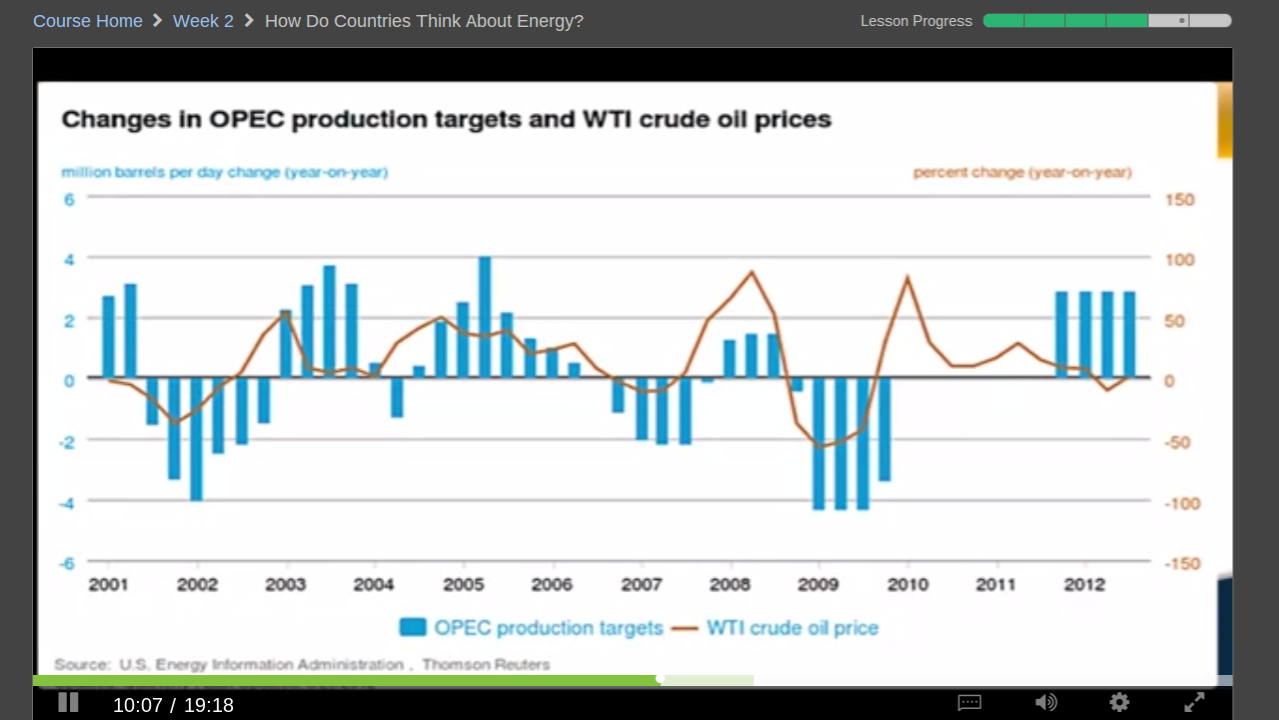
Oil demand is 75 million barrels per day (17% passes through Strait of Hormuz - choke point) - OPEC produces 30 mbpd. Saudi Arabia primarily controls the price.

OPEC production and Oil price relations

Solar energy can be obtained @ 300 BTU/hour/square foot. 1Kw/Square metre. Best position for it is to have it tilted south, the optimum tilt = latitude directly south. Best option is two axis tracking flat plate.

Solar Panel angle

Summary

Energy Conversion - 55% energy resources are lost due to inefficiency of conversion process


Coal power plant


Wind Turbine


Alternative solar technologies

A look at the efficiency levels of various power producing technologies shows that these technologies have a lot of room for improvement, despite some of them being several decades old. Efficiency improvements could in itself do so much in reducing our carbon footprint and damage to the environment. Add to that, the plant capacity utilization on an annual basis being about 40-50% means there is a mismatch between supply and demand.

Electric Technology Efficiencies
Renewable Energy Technology Efficiencies

84% of the global warming 'effect' is because of CO2. 10% from methane.  A molecule of methane causes 25 times more damage than a molecule of CO2.


70% of oil is used for transportation, so how good environmentally are electric cars. Electric cars are not zero emission since electricity production emits CO2. An electric car needs 0.34 kw-hr / mile. 1 kw-hr produces about 1.2 lbm (545 grams) of CO2. Hence for each mile driven, amount of CO2 emitted is 0.4 lbm. Gasoline driven cars emit about 19.6 pounds/gallon. So depending on cars mileage, you can calculate CO2 emission/mile. For a prius hybrid which does 50 mpg, CO2 emission is equivalent to an electric car. // The prof is super anti-electric cars, so numbers used might be a little biased ;)

Toyota Prius is a hybrid car which uses braking energy to energize the car, high MPG. No electricity required, same range as gasoline car. Chevy Volt is a plug-in hybrid car which runs 40 miles just on battery and then switched to a gasoline/electric hybrid. Has a good range. Nissan Leaf is an electric car which doesn't need any oil, but range is limited to 100 miles or so. Upto 300 miles on a Tesla but the prof doesn't say so. 

Ocean Energy - Wave energy requires large areas to be adopted, Tidal energy would get in the way of navigation and infrastructure requirements are too high. Lightning energy is too sporadic in time and location. Electric power transmission/distribution - 'Smart grid' is being implemented, DC (long distance) versus AC (usable, less line loss), wireless has limited use. Solar/Wind Electric energy storage is economically not very viable as yet.

Sunday, August 30, 2015

Sustainable Development by Jeffery Sachs

Took this awesome course on Coursera - here are my notes from it.

World Population has been hovering around 300-400 million from 2,000 years ago to 1750. Due to medical advancements began to increase and reached 1 billion in 1830, 2 billion in 1930, 3 billion in 1960, 7 billion in 2011 and 8 billion expected in 2024. IMR in 1950 134, 37 today. Life expectancy 47, 71 today. 1 billion people still struggle for daily survival. Avg Annual Income/person is $12000 - World economy = $80-90 trillion (this has a huge impact on environment)

Term given by scientists - Anthropocene Age - Age of humans
Due to human intervention, there have been major changes in earth even from geological point of view. Fossil fuel (coal, oil, gas) use leading to CO2 emissions causing climate change leading to massive changes to life on earth (temperatures rising, frequent extreme weather conditions, glaciers melting, nitrogen and phosphorous cycle altered, high fresh water usage, loss of biodiversity, oceans acidic, air polluted, chemical pollution, ozone depletion, deforestation.

"We honor and respect planetary boundaries as we improve our well being, a combination of economic prosperity, social inclusion, ending poverty and ensuring environmental sustainability that is the holistic objective of sustainable development."

Business as usual will have some benefits such as economic growth but will it be socially inclusive? could eventually be very violent outcomes. BaU keeps transgressing beyond the planetary boundaries and the environmental dangers of that are much more extreme and dangerous. One path to improvement is to use technology in a clean manner. Essence of sustainable development is problem solving

Income inequality is a major factor - some countries have $50,000 annual income others have < $500 even though a few centuries ago they were all at the same (very low) level of income equality. Industrial revolution led to some parts of the world experiencing sustained increase of growth making them rural to urban centred, peasant agriculture to modern industry.

Agriculture advent 10,000 years ago till Industrial revolution (1750) economic growth was very very slow, since then its grown exponentially, due to output/person increase and high population growth. Lack of growth is explained by Keynes as the absence of technological growth and lack of capital accumulation.

Agriculture productivity increased due to learning, urbanization, trade, property rights, rule of law taking hold, especially the steam engine invention by James Watt (1776) was a major component of the industrial revolution. (technological trigger). There were special conditions also, coal and iron ore deposits near england and the above changes allowed for the industrial era. Adam Smith (father of economics) published Wealth of Nations and the American colonies declared independence in 1776 also. Modern world economy was being set in new industrial/factory towns with steam engines pulling rail roads and steam ships transforming transportation and coal burning in factory towns. In summary, natural resources combined with technical know-how and spreading market economy helped start industrialization.

Karl Marx detailed this growth in world economy but highlighted the bourgeois as the new capitalists who were pushing all other classes into the background.

New modern economic growth was under way, markets and technology drove this economy in a few places at first but slowly in the entire world. Economic growth = increase in GDP/person, or Gross World Product/World Population, has gone up significantly over 200 years but with vast disparity in different regions of the world. England was the tech leader in early 19th century, then mid-late 19th century Germany and early 20th century USA took over. Innovations and tech advancements allowed them to have a stronger sustained growth.

Other countries, due to various reasons, stayed back while others coasted ahead (eg China did not industrialize at that time), developing economies are doing so now, trying to close the gap by taking on those technologies. Leaders innovated, followers replicated through investments, copying etc.. Both required different types of institutional development.

Endogenous growth of technological leaders came in 5 tech advancement waves.
1) Steam Engine - 1770-1830
2) Railway and Steel - 1830
3) Electricity - Incandescent bulbs (Edison) - 1880-1930
4) Auto-mobiles, petrochemicals (plastic/new materials) and innovation (Model T - Henry Ford) 1930-1960
5) Knowledge economy - Computers - Transistor 1970 - 2000 (Moores law - double processing every 18-24 months)
Could the 6th wave be a sustainable development technology?

Diffusion of knowledge to other nations happened sooner in some places than others, some 2 billion people still dont have access to electricity. Diffusion of technology didnt happen in many places due to various factors, esp proximity/ access to market, due to sea trade (development at coasts before inland), predicted by Adam Smith. Strong agriculture is a second factor allowing for industrial development in cities. Local energy resources allow a big advantage in speeding up economic growth. Healthy environment for humans helps the diffusion factor and good politics is critical to the growth.

The development started with Great Britain in Europe, and the diffusion happened in a ripple like manner spreading eastwards. It then spread to new settlements like USA, Australia, Canada and then to countries with favourable climate (temperate) Argentina, Uraguay Chile, Japan. Most of the rest of the world had to wait till latter portion of 20th century. Big factor, no independence, no sovereignty. British and French empires had control over all of Africa and most of Asia disallowing diffusion to happen there because they wanted to maximise their own well-being at home. Using them as primary sources for low pay labor not as areas of economic development.

Economic development had grown steadily for imperialist powers until the first world war which led to severe destruction, epidemic such as flu, Bolshevik revolution leading to Soviet era communism, economic instability and role in economic depression leading to rise of fascism forces such as Hitler leading to World War two. Technology had advanced, technology leaders had taken a big hit but USA was unharmed and became the strongest, most influential economy.

Post WWII, the world was divided into 3 parts, first world was US, Eastern Europe and vanquished Japan. Richest group.Market economic system trading amongst each other, technological change leader, Second world was Soviet Communism, (soviet union and 17 republics of Western Europe) and China. Third World were the former colonial powers (with weakened imperial powers they had become decolonized; gained freedom/independence this process took a few decades) India, Indonesia, Africa, rest of Asia etc. Third world countries were non-aligned with the top 2 worlds. There also are 4th world countries which are in absolute, abject, poverty.

First world recovered very quickly, endogenous technology driven economic growth took hold, modern economic growth and rising living standards. Second world had industrialization but by the 70's economic development under non-market communism system slowed things down, they began to reform starting with China, under Deng Xiaoping, which grew very very fast. Russia reformed towards a open market economy under Gorbachov in the 80's, then eastern Europe countries revolutionised. Third and fourth world had diverse backgrounds, economies and strategies and very few followed the first world model (such as Korea, Taiwan, Hong-Kong, Singapore, the Asian Tigers) who integrated with the first world and opened their country to foreign companies to manufacture/develop products there, becoming a part of the global economy. a special kind of industrialization. They grew very quickly in the 60's-70's. Other developing countries saw this and decided to become aligned (not politically but economically) and opened their doors to trade and investment, allowing MNCs to use their cheap labor and resources. This is how globalization came into being. Diffusion, allowing countries, to grow and a new global industry centred around MNC doing global production backed by improved technology, transport (inter-modal - containerization of trade), computer assisted design and manufacture, internet and mobile telephony revolutionized the ability of companies to engage global production systems. Hence, the companies became the main agents for continuing the ripples of diffusion of economic growth.

Japan, described this as the flying geese model. A formation in which they all follow each other. Japan industrialized followed by Asian Tigers, then Indonesia, Malaysia, Thailand, China, Vietnam, Cambodia, Laos. As the leading country moved from textiles to electronics to auto mobiles to advanced info tech, the country behind it moved from agriculture to textile to electronics into its own technology innovation and the geese follow one after the other.

Coastal areas were the first to advance (as predicted by Adam Smith), China invited investments and became an export base for world manufacturing production. By the end of the 20th century, the spread of economic developed had reached the entire world, almost. Those that came late to this, due to their history, politics, resource base are low income and least developed countries.

Sustainable development makes the point that economic, social and environmental systems are interlinked. Need to understand the environment systems so we can balance the three, economic growth, fairness and social inclusion and environmental sustainability. In search for economic development, we have passed some of the planetary boundaries. We need to quantify the safe limits of economic growth to stay within planetary boundaries.

Climate change is the biggest challenge, caused by fossil fuel use which produces some gases (Co2, Nitrous Oxide, Methane) that allow sunlight in but traps the energy on its way out, leading to planet warming up. Ocean acidification comes from CO2 levels in the air. (dissolving into ocean forming carbonic acid), various animal life is affected. PH of ocean has decreased by 0.1 unit (30% acidity increase). Ozone depletion CFCs used in various equipments would cause ozone to dissociate, especially across Antarctica in 1998. Nitrogen/Phosphorous loading - Only some of the fertilizer is taken up by the crops, a lot of fertilizer goes into the soil and into water/rivers. Causes a lot of ecological destruction. Fresh water use - 70% of fresh water used for irrigation, 20% for industry, 10% for households. Water sources being depleted due to over-pumping. Land being taken over from pastures/forests to farming. Other species going into extinction. Aerosol loading -  Air-pollution, damaging for lungs, and the environment Chemical pollution - Mining, petrochemical, steel industries produce deadly chemicals which damage human, animal and plant life. Biodiversity loss - All of the other factors above, make species disappear at a very fast rate. We are causing the 6th extinction wave of planet earth. All previous ones were naturally caused.

Humanity is causing major dislocation, 6/7th of population looks to locate to developed countries. To reconcile economic growth and planetary boundaries we need to grow in a different way. Different energy, transportation, food production methods. Problem is lesser developed countries have a lot of catching up to do in economic development and this growth can do more damage to the environment. 


Growth Convergence Theory - Country at half the annual income / capita of another country, can grow at 1.4 % points more than the growth of the leading country
  
So essentially, developing countries are growing (economically) faster and given the population growth, we will be 9 billion people by 2040, by end of 21st century we will be near 11 billion. Currently World growth is @ 1.1% by 2100 it will be close to 0% growth. World economy would be worth about $ 270 trillion (given no massive natural disasters)

Energy
Pre-steam engine, there wasnt a way to have sustained economic growth due to lack of energy creation capacity. Fossil fuels were our friends at that time, but now they are our enemies due to greenhouse gas emissions caused by them. Energy efficiency is not sufficient, more energy is required from sustainable sources. For every $1,000 increase in Annual income/person, energy production/person increases by 0.19 tonnes of oil. 1 tonne of energy production releases 2.4 tonnes of CO2 into the atmosphere. Coal sourced energy equivalent to 1 tonne of oil creates 4 tonnes of CO2,  From Oil, its 3.1, for gas equivalent its 2.4, for hyrdo-electric, solar, nuclear etc its 0.

In 2010, World economy was $68 trillion, * energy use/unit of economy (.19) * amount of CO2 released/unit of energy (2.4) = 31 billion tonnes of CO2 emission. We emit CO2 in other ways also, eg cutting trees. 54% of CO2 emitted goes into natural sinks (ocean, plants). So nearly 14 billion tonnes of CO2 stays in the atmosphere due to 2010 human activity.

For every 7.8 billion tonnes of CO2 put up in the atmosphere, the concentration of CO2 goes up by 1 ppm. 

In the last 800,000 years, its hovered roughly between 200-250 ppm. In the last 100 years, its gone up to 400 ppm, which is a seriously deadly change. 450 ppm would mean a temperature increase of 2 degrees since the industrial revolution = massive climate changes and disproportionate ones.

Were expected to reach 450 ppm at current production levels in 25 years. Assuming no change in world economy growth. But as read earlier, its expected to triple i.e. 5-6 ppm increase in CO2 concentration annually. We have to change course very very quickly otherwise were headed for massive global disaster. Solution in the form of solar, wind power technologies are getting cheaper and must be adopted.

Food
Agriculture sector has a larger impact than energy. It causes impact on every aspect of earth systems and planetary boundaries (Nitrogen/Phosphorous cycles, biodiversity loss, land use change, fresh water use, chemical pollution) and GHG emissions (climate change). Malthus (Principles of Population - 1798), population would increase geometrically, food production would increase arithmetically, so eventually people would starve due to the variance and hence bring things back to normal, he didnt anticipate food production increase accurately but he was right that current food production rates arent accomplished sustainably. Sustainable development calls for a reform, upgrading of tech systems to grow food. Also for us to eat wisely, not eat endangered species etc.

1- Apart from CO2 caused through production and use of fertilizers, as well as through agriculture production processes (harvesting, sowing etc) agriculture produce transportation, storage etc, other GHGs such as methane are produced through (uncontrolled) anaerobic digestion into the air, animal digestions and Nitrous Oxide is emitted through chemical decomposition of nitrogen based fertilizer into rivers and oceans.

2- Food production increase has required a takeover of the habitat by agricultural production from various other species, hence their numbers are falling and becoming extinct. 3- By relocating various plant species we are re-adjusting bio-geography (invasive species) leading to local species coming under threat.

4- Overuse of nitrogen and phosphorous, increases its presence in water systems leading to algae bloom, which when decomposing reduces oxygen content in the water (hypoxia) leading to fish and other species dying, especially in dead zones which are becoming common in estuaries (where fresh water rivers mean salt water oceans).

5- Industrial breeding of poultry leads to recombination of genes and viruses resulting in infectious diseases such as SARS. 6- Overuse of water for food production purposes leads to water scarcity which is dangerous for human development.

New farm systems are required based on local soils, local climate, culture, ecological conditions which are sustainable.

Population
More the population, bigger the challenge of sustainable development. (social inclusion, ending extreme poverty, respecting the planetary boundaries). Population forecasts are very sensitive to slight changes in fertility rates. The expected population in 2100 is 10.8 billion.

Literacy, age of marriage, access to contraception, gender discrimination, labor force participation, rural-urban mix, child survival rates, abortion legalization are all major factors of fertility rates.

---------------------------------------------
Must say this was an awesome experience. I hope i continue taking more courses and wish more people utilize this opportunity to learn about the world and its people.
Custom Search